Modular Classrooms Are Redefining How Fast K–12 Schools Can Expand
K–12 districts across the country are all facing the same pressure: more students, limited space, and not enough time to build. Modular classrooms change that equation, turning “we need rooms next year” into “we opened on time this fall” far more often than most facilities teams think possible. Modular construction lets schools add high-quality classrooms in a fraction of the time required for traditional builds, because most of the work is done off-site while school is still in session. Foundations, utilities, and sitework are handled on campus while classroom modules are built or renovated in a controlled environment; then everything comes together during a compressed on-site window, often a single summer and sometimes just a few weeks. The result: new classrooms ready for students, without sacrificing an academic year to construction.
How the Modular Classroom Timeline Really Works for K–12 Districts
A typical K–12 modular expansion follows a familiar rhythm. Districts begin with a needs assessment and target opening date, often tied to the next school year. From there, design, permitting, and procurement move in parallel, shaping how many classrooms are needed, how they connect to existing buildings, and whether the solution should be temporary (leased) or permanent. While decisions are being finalized, modules are fabricated or refurbished off-site, so by the time school lets out for summer, much of the building is already complete.
That overlap is where the time savings show up. Instead of waiting months for a building to rise in place, districts see a short, intense period of visible activity on campus: foundations and utility work, delivery and craning of modules, and final fit-out. Commissioning, inspections, and teacher move-in all happen in the final days before the first bell, but the heavy lifting has already happened in the factory and during the early sitework phase. For facilities leaders, the timeline shifts from “How can we build this in a year?” to “How do we make the most of a 10–12 week summer window?”
From Late-July Panic to On-Time Opening at Carpenter Elementary
Carpenter Elementary School in Wolfeboro, NH, offers a clear example of what “fast” really looks like. The district came forward at the end of July, just weeks before the first day of school, needing additional classroom space for the upcoming year. On top of the schedule crunch, the site presented logistical challenges: narrow roads, low wires, heavy tourism traffic, and a grass field that needed to be protected.
Triumph delivered a turnkey modular classroom building addition using two 28′ x 66′ classroom box units and one 12′ x 64′ Silverline unit, complete with ADA-compliant ramps. Daily coordination between Triumph, district leadership, and the town helped streamline permitting, site preparation, transportation, and installation. Modules were delivered, set on specialized foundations, connected, and finished in time for teachers to move in before students returned. Instead of scrambling for temporary solutions, the school opened on time with modern, code-compliant modular classrooms in place.

Modular classroom at Carpenter Elementary School
One-Day Modular Classroom Sets Across Three Boston Public Schools
When three Boston elementary schools needed additional classrooms for the new school year, the district couldn’t afford prolonged disruption in tightly packed urban neighborhoods. Streets around the schools are narrow, schoolyards double as community spaces, and neighbors are understandably sensitive to noise and truck traffic.
Triumph’s approach was to do as much work as possible away from those neighborhoods. Existing modules were renovated off-site in the spring while classes continued, upgraded to meet Boston Public Schools’ standards for finishes and performance. Once school let out in June, sitework began at each location, carefully sequenced to minimize impact. The classroom buildings themselves were delivered and set in a single day per site, leaving the remaining summer weeks for ramps, utility tie-ins, and final finishes. By the time students arrived, all three schools had new modular classroom buildings online and teachers had time to make the spaces their own. View our project for Boston Public Schools here.
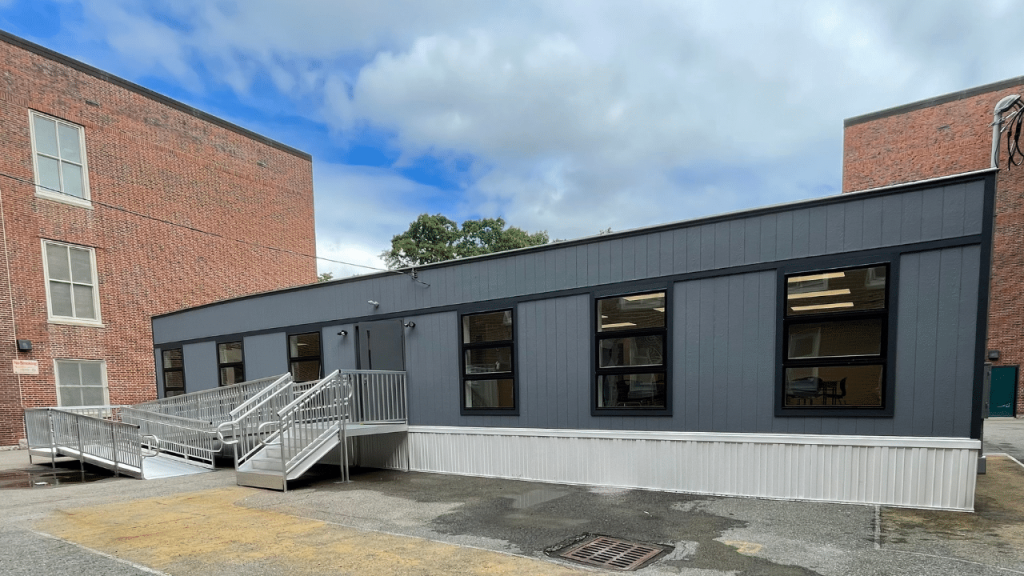
Modular classroom for Chittick School – Boston Public Schools
Delivering Fifteen High School Classrooms in a Single Summer
Some districts need more than a few extra rooms, they need major capacity fast. Lexington High School was one of them. The school needed a large, long-term solution but had only a single summer break available for on-campus construction. Extending work into the school year would have meant significant disruption for thousands of students and staff.
Triumph delivered an 18,000-square-foot permanent modular building that added 15 full-size classrooms, designed to integrate with the existing campus. Much of the structure and interior work took place off-site during the school year, allowing the on-site phase to concentrate into the summer months. By the time students returned, the new building was complete and operational, delivering a durable, permanent solution without sacrificing an academic year to construction fences and staging areas.
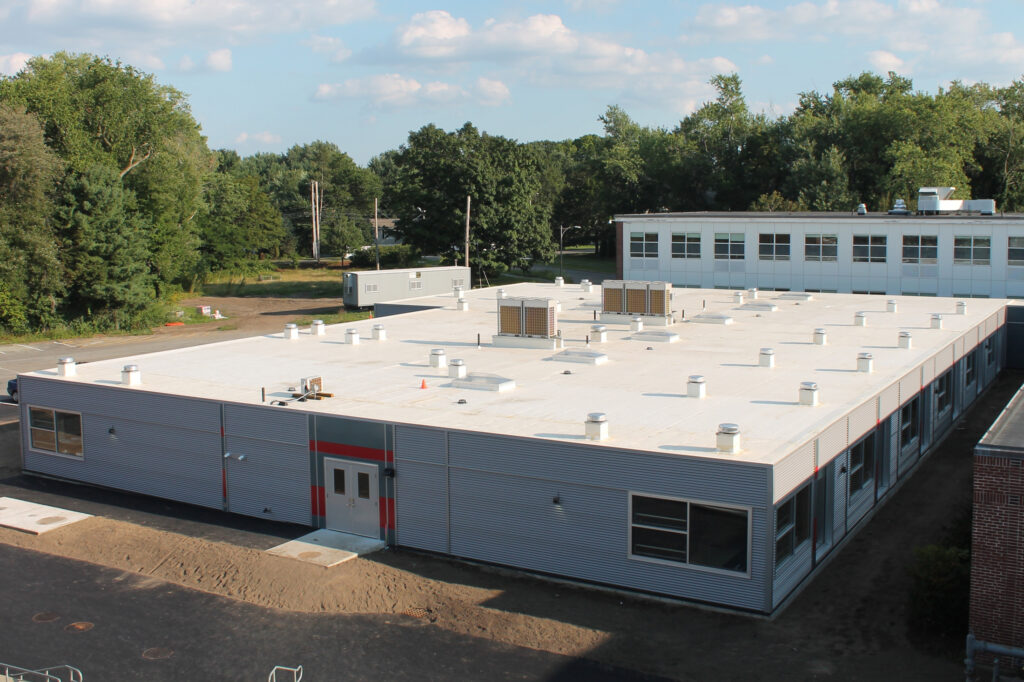
Lexington High School’s 18,000 sq ft. modular addition from Triumph Modular
Fast-Track, Energy-Efficient Capacity at Whittier Middle School
At Whittier Middle School in Haverhill, MA, the challenge was to add capacity while meeting ambitious energy and code requirements. The district needed more space quickly, but not at the expense of long-term performance or compliance with the Massachusetts stretch energy code.
Triumph delivered a 6,385-square-foot modular addition made up of seven 14′ x 70′ modules, providing six classrooms and capacity for 228 occupants. The building features Hardie lap siding, vinyl windows, and a flat EPDM roof, designed to complement the existing campus and meet local code requirements. With turnkey delivery, including utilities and foundation work, the district gained efficient, high-performance space that aligned with its long-term facilities and sustainability goals.
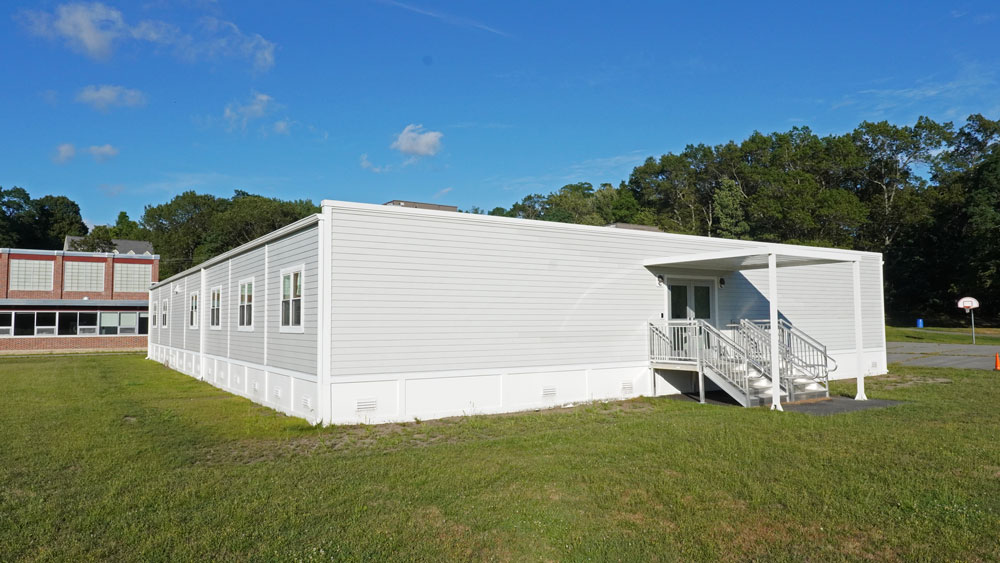
Modular classroom addition for Haverhill MA – Whittier Middle School
Two Elementary School Additions in About 18 Weeks
Hopkins and Elmwood Elementary Schools in Hopkinton, MA, both needed additional classrooms, and the district wanted both projects completed before the next school year. That meant designing, coordinating, and delivering two separate additions on a shared schedule.
Each addition used five modules: four 14′ x 60′ modules stacked two over two, and a fifth module stacked lengthwise to tie into the existing building. Triumph relied on Building Information Modeling (BIM) during preconstruction to plan connections and minimize surprises on site, completing about 95% of the work off-site. On campus, crews were on site for only about 20 days at Elmwood, and both projects were completed in roughly 18 weeks from the start of construction through final completion. For the district, that meant two new classroom additions, delivered in one summer, that matched existing classroom dimensions and performance.
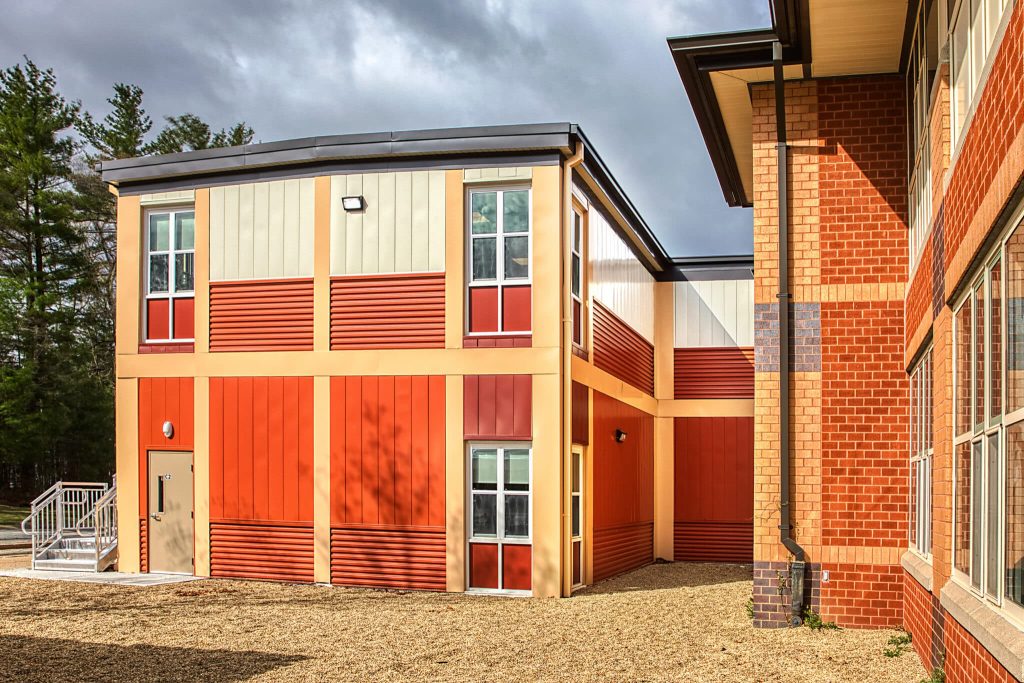
Modular classroom addition for Hopkinton Public Schools
Start With Your Must-Meet Opening Date and Plan Backward
Across these projects, a pattern emerges: short, predictable on-site windows, parallel off-site and on-site activity, flexible delivery models, and turnkey coordination that protects schedules. Work on campus is focused into weeks rather than months, often aligned precisely with summer break, while modules are built or refurbished off-site to compress overall timelines. Districts can choose leased temporary classrooms for short-term needs or permanent modular buildings for long-term growth, without losing a school year to construction.
Whether you’re dealing with sudden enrollment spikes, swing space for renovations, or long-term growth, the most important planning move is to start with your must-meet opening date and work backward. From there, you can decide which projects demand temporary space, which require permanent buildings, and how much work you can shift off-site to protect instructional time.
K-12 Modular Classroom Expansion Timeline Examples
Temporary and permanent delivery windows across districts
| District / School | Project Type | On-Site Window | Total Delivery Window | Key Outcome |
|---|---|---|---|---|
| Carpenter Elementary School | Temporary | Late July–August | Weeks from request to day-one readiness | Opened on time with urgent capacity |
| Boston Public Schools (3 sites) | Temporary | June–August (one-day set/site) | Spring refurb + single summer | Three schools ready for first day |
| Lexington High School | Permanent | Single summer break | School-year planning + summer build | 18,000 sq ft / 15 classrooms on time |
| Whittier Middle School | Permanent | Compressed turnkey on-site | Coordinated with stretch-code and schedule | 6,385 sq ft, energy-efficient addition |
| Hopkins & Elmwood Elementary | Permanent | ~20 days crew time | ~18 weeks start to finish | Two additions delivered in one summer |